


Sometimes referred to as Somalia's most famous export, model and
business executive Iman was one the most sought-after supermodels of the
1970s and '80s. Discovered by photographer Peter Beard on the streets
of Nairobi, she quickly became a stunning and exotic face for the
American public. In the 1990s, she launched her own line of ethnic
cosmetics. She is married to rock musician David Bowie.
Model, business executive. Born Iman Mohamed Abdulmajid on July 25, 1955, in Mogadishu, Somalia. Iman is sometimes described as her native land's most famous export.
One of the most sought-after fashion models of the 1970s and 1980s, Iman became a successful business executive in the 1990s with her own line of cosmetics. Married to rock star David Bowie since 1992, she became a mother for the second time at the age of 44 in the summer of 2000, but it was just one of many boundaries the enigmatic entrepreneur and social activist has broken in her lifetime. "She broadened the definition of beauty," declared Washington Post writer Robin Givhan of Iman's stunning, exotic looks. "She made earthiness sensual. She helped to transform fashion into entertainment and models into personalities."
Iman's mother, a gynecologist, gave her daughter a man's name when she arrived into the world with the hope that this would better prepare her for the challenges she would face as a female in Muslim East Africa. Her parents were decidedly progressive: Iman's father was a diplomat stationed in Tanzania, and under the law he could have had multiple wives, but chose to keep just one. The parents agreed that their daughter should be sent to a private Catholic school for girls, which was considered more progressive than the standard Islamic education available to young females in the 1960s. There, Iman thrived. "I was a very nerdy child," she told husband David Bowie when he interviewed her for Interview in 1994. "I never fit in, so I became laboriously studious."
Beard shot rolls of film of Iman that day, and took them back to New York with him. He then spent four months trying to convince his "discovery" to move to New York and begin modeling professionally. He even leaked items to the press about her fantastical beauty, and exaggeratedly claimed that she was descended from African royalty and that he had "found" her in the jungle. Another story alleged that she was a goat herder in the desert. When Iman finally capitulated and flew to New York, dozens of photographers greeted her at the airport. A press conference that day initiated her into the vagaries of celebrity and fame. "I was very surprised and offended that they could be so gullible to believe that all Africans come out of the jungle,
" Iman told Campbell. "Somalia is a desert. I had never even seen a
jungle. And I was even more insulted when they started asking the
questions and talking only to Peter because they thought I did not speak
English and I could speak English and five [other] languages."
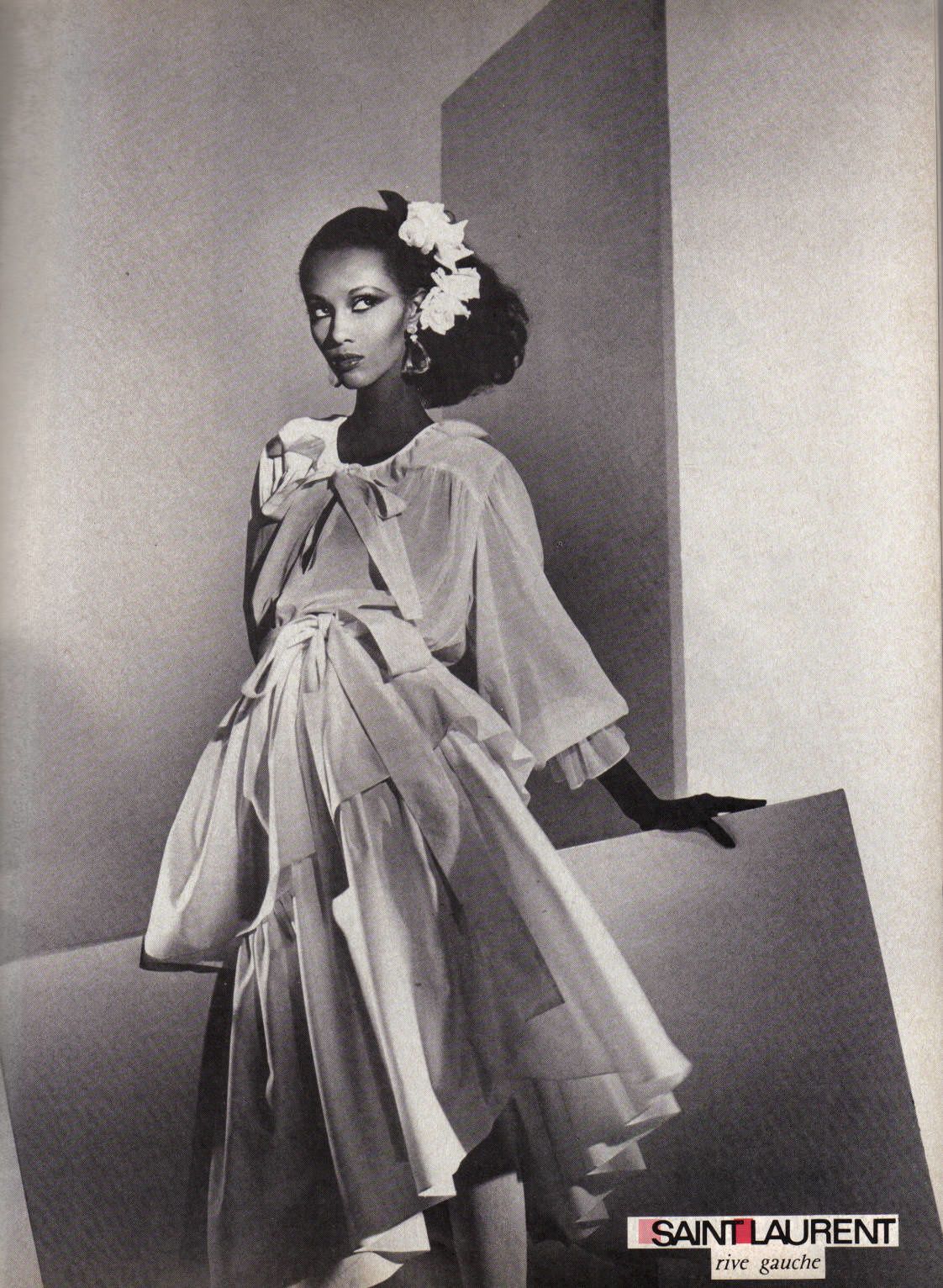
Signed to the modeling agency Wilhelmina, Iman began a career on haute-couture runways and in the pages of fashion magazines such as Vogue and Harper's Bazaar. She was instantly a favorite with designers and editors alike, and was one of first models in her day to be successful in both print and on the runway. French couturier Yves Saint Laurent even devoted a collection to her, "The African Queen," and one of the most famous images of her career was a shot of her striding down a Paris runway in a Thierry Mugler design with a leashed leopard at her side. She led an admittedly jet-set life, as she told the Washington Post, and often squandered her earnings. "You earn an extraordinary amount of money almost for nothing at a very young age," she told fashion writer Givhan. "I'd spend all this money to take the Concorde to Paris for a party and then come back. And I didn't do it just once. [Modeling] doesn't prepare a young girl for the future."
In 1978, Iman married basketball star Spencer Haywood, with whom she had a daughter. She continued to model, but was sidelined for a time in 1983 after a taxi wreck. In 1987, she and Haywood divorced, but a custody battle over their daughter Zulekha, who lived with her father in Detroit, endured for six more years. In 1989, Iman quit modeling altogether. She was adamant about leaving the business permanently and not staging a comeback, as she told Bowie in 1994, "because then there is no grace in it," she said in Interview. "So, when I decided to leave, I made sure that there was no cushion for me to go back to in New York. I sold my apartment; I severed contacts there, except with my friends, so that I would never have the excuse that, when something went wrong, I could go back to that as a cushion. I think I made one of the best decisions I've ever made for myself."
Iman moved to Los Angeles, where friends introduced her to the English rock legend in 1990. They were wed in Lausanne, Switzerland, on April 24, 1992, and were remarried in an Italian church two months later. Initially, their relationship seemed improbable to many, and it was even suspected to be some sort of publicity stunt, but Iman and her husband have proved one of the more enduring rock/fashion couplings of the modern age. Over the years, Iman made several film appearances, but the big screen failed to fully capture her grace and energy. She found a far more worthy outlet for her talents, however, in 1992, when she convinced the British Broadcasting Corporation (BBC) to let her take a documentary film crew to Somalia, which had been ravaged by war, drought,
and famine. Iman decided that her status as Somalia's most famous expatriate could be leveraged to help raise awareness of the tragedy and bring in more international aid. As she explained to People writer Ron Arias, she set out determined to "let the Somali people speak for themselves. People get numbed when they see picture after picture, year in and year out, of people starving. I wanted to show that they are not a nation of beggars — that culture, religion, music and hope are still there."
Iman and the BBC crew arrived to film Somalia Diary just weeks after her honeymoon. It was her first visit in 20 years, and she barely recognized places like Baidoa, where she and her family had vacationed when she was a child. Instead of a thriving market town, she found emaciated people clothed in rags, and adolescents toting automatic weapons. "It reminded me of the movie Mad Max, " she told People. The making of Somalia Diary proved a dangerous and difficult time, but Iman was also able to visit family and even her former childhood home in Mogadishu, in which three refugee families were by then living. On one day of filming, she and the crew followed the bus that went through the town collecting the day's fatalities. "[T]hat was the worst part," she said in the People interview with Arias. "I stopped because I couldn't go through the whole thing. The count was 70 dead that day, and most of the bodies I saw in the sacks were children under 10."
In 1994, Iman launched her own line of cosmetics for women of
color. She had long been frustrated by the paucity of products for
black skin. "I would go to cosmetics counters and buy two or three
foundations and powders, and then go home and mix them before I came up
with something suitable for my undertones," she said in an interview
with Black Enterprise writer Lloyd Gite. Teaming with Byron
Barnes, a onetime makeup artist who had helped create a previous line of
cosmetics for women of color, Iman came up with an innovative product
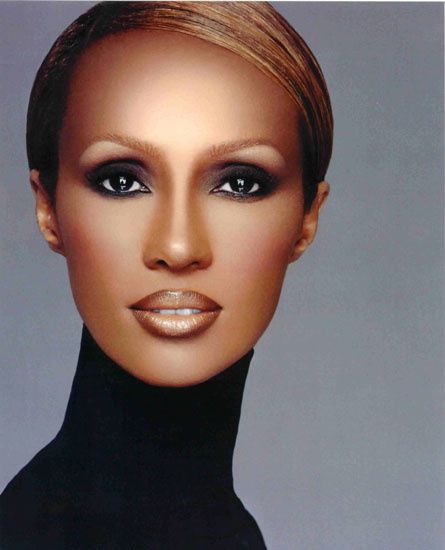
line, and packaged it with her own name and very recognizable visage.
The Iman Collection was aimed at all women of color — Hispanic, Asian,
Native American, as well as black — and was sold at J. C. Penney stores
across the United States. Like her modeling career, Iman's newest
venture was an immediate success, but she soon realized that a company
as small as hers did not have the capability to expand. The Iman
Collection had neither an advertising budget nor a sales staff, and when
its products sold out quickly, it took weeks to restock. Poor planning
also hampered
the business in the first year — for instance, there were not enough products for Asian skin types in West Coast stores, while too many languished on store shelves in the Midwest. "In the first year, I have found everything that could go wrong in this business," she told Knight-Ridder/Tribune News Service writer Campbell in a 1996 article.
Perhaps even more ominously,





/image%2F0023199%2F201303%2F1364291719.8027.jpeg)
/image%2F0023199%2F201303%2F1364291717.1752.jpeg)
/image%2F0023199%2F201207%2Fob_60a1539341297228744ac058667765e9_joan-smalls-fendi.jpg)
/image%2F0023199%2F201206%2Fob_90cdc3_arlenis-sosa-summer-2012-style-guide-bloomingdale.jpg)
/image%2F0023199%2F20140123%2Fob_3c8423_aptopix-ukraine-pr-1729353g.jpg)
/image%2F0023199%2F20140120%2Fob_e43c05_1522240-566601983431572-1677881303-n.jpg)
/image%2F0023199%2F20140119%2Fob_cb87b7_banner-tablette3.jpg)
/image%2F0023199%2F20140119%2Fob_05f3aa_4451811640-b9a0cbf282-o-420x280.jpg)